

Life Insurance That Protects What Matters Most
Life insurance is about more than leaving money behind. It can help protect the people you care about, replace income, pay debts and final expenses, and provide financial stability when your family may need it most.
Whether you’re considering term coverage, permanent life insurance, an indexed universal life policy, or final expense coverage, we’ll help you understand the differences and explore options that fit your goals, budget, and stage of life.
Which Type of Life Insurance Is Right for You?
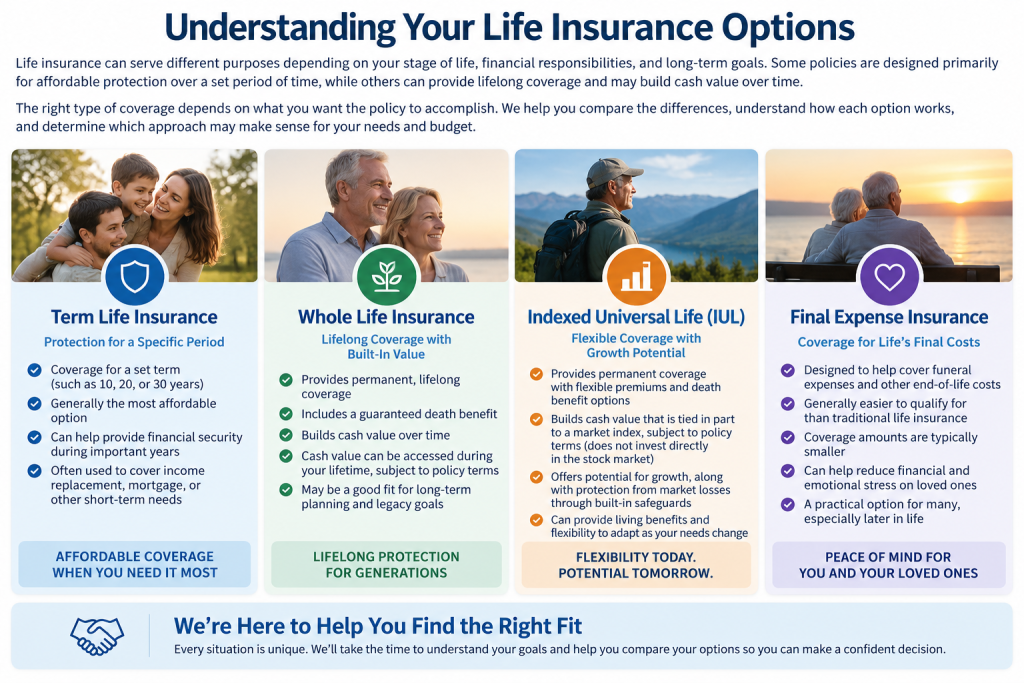
Life insurance can serve different purposes depending on your stage of life, financial responsibilities, and long-term goals. Some policies are designed primarily for affordable protection over a set period of time, while others can provide lifelong coverage and may build cash value over time.
The right type of coverage depends on what you want the policy to accomplish. We help you compare the differences, understand how each option works, and determine which approach may make sense for your needs and budget.
How Much Life Insurance Do You Need?
There isn’t one coverage amount that’s right for everyone. The amount you may need depends on the financial responsibilities you want to protect, the people who depend on you, and the resources your family would already have available.
A useful estimate considers more than income alone. It should account for the obligations you would want covered and then subtract financial resources already available to meet those needs.
- Mortgage or housing costs
- Outstanding debts
- Final expenses
- Income replacement for your family
- Education and other future obligations
- Emergency or family financial reserves
- Legacy planning — Money you want to leave to children, grandchildren, or other loved ones.
- Charitable giving — A planned gift to a religious organization, nonprofit, charity, or other organization important to you.
From there, existing life insurance and financial resources that you intend to use for these needs can be considered. The difference can provide a useful starting estimate of the amount of additional coverage you may want to explore.
Our Life Insurance Needs Calculator will help you estimate potential coverage needs based on your financial obligations, family goals, existing coverage, available resources, legacy planning, and charitable giving.
Life Insurance Can Do More Than Provide a Death Benefit
While the death benefit is the foundation of life insurance, some policies may also provide benefits that can be used during your lifetime. Depending on the type of policy and its features, these can include access to certain living benefits, cash value accumulation, and additional financial flexibility as your needs change.
Living benefits may allow access to a portion of a policy’s death benefit during the insured’s lifetime when certain qualifying conditions are met, depending on the policy. Cash value, available with certain permanent policies, can accumulate over time and may be accessed through withdrawals or policy loans, subject to the policy’s terms, charges, and potential effects on the death benefit.
Living Benefits
Some policies include living benefit riders that may allow you to access a portion of the death benefit if you experience a qualifying event, such as certain chronic, critical, or terminal illnesses. Availability, qualifications, and benefits vary by policy and carrier.
Cash Value
Certain permanent life policies can build cash value over time. Depending on the policy, that value may be accessed through withdrawals or policy loans for a variety of needs. Accessing cash value can reduce the policy’s value and death benefit and may have tax consequences.
Protecting the People and Responsibilities That Matter
Life insurance can help provide financial stability when the people you care about are dealing with an already difficult loss. The purpose of the coverage will be different for every family, but the goal is often the same: making sure important financial responsibilities don’t suddenly become someone else’s burden.
Coverage can help a surviving spouse or family maintain their standard of living, provide time to adjust financially, support children’s future goals, protect a business or business relationship, and create a legacy for loved ones or organizations that matter to you.

Final Expense & End-of-Life Planning
Final expenses can create an unexpected financial burden for the people you leave behind. Funeral or cremation costs, medical bills, outstanding debts, and other end-of-life expenses can add up quickly at a time when your family is already dealing with a loss.
Final expense coverage is generally designed to provide a more modest death benefit specifically intended to help with these costs. For some people, it can be a standalone solution; for others, it may complement existing coverage by providing money specifically for expenses that arise at the end of life.
Making Things Easier for the People You Love
Planning ahead can involve more than having money available. Keeping important documents organized, making your wishes known, identifying key contacts, and discussing arrangements with family can help reduce uncertainty during an already difficult time. Coverage can provide the financial piece of that plan, while preparation can help make the process easier for everyone involved.
Life Insurance for Business Owners
For a business owner, protection may need to extend beyond the family. The loss of an owner, partner, or key employee can affect employees, customers, business relationships, outstanding obligations, and the future value of the company.
- Key person protection — Helps provide financial resources if an important owner or employee dies.
- Buy-sell planning — Coverage may help provide funding for an ownership transfer when structured as part of a buy-sell arrangement.
- Business obligations — Can help provide funds for debts or other financial commitments.
- Business continuity — Provides financial resources that may give the company time and flexibility to adjust after the loss of an owner or key person.
Permanent Coverage & Indexed Universal Life
Permanent policies are designed to provide coverage that can remain in force for life, provided required premiums are paid and the policy remains adequately funded. Unlike term coverage, certain permanent policies may also accumulate cash value that can become part of a broader financial strategy.
Indexed Universal Life (IUL) is a type of permanent coverage that offers flexible premium and death benefit options and the potential to build cash value. Interest credited to the policy is linked in part to the performance of a market index, subject to the policy’s crediting method, participation rates, caps, floors, and other terms. The policy does not invest directly in the stock market, and index performance does not guarantee a particular policy result.
An IUL policy needs to be designed, funded, and reviewed with its long-term purpose in mind. Policy charges, changes in credited interest, premium payments, loans or withdrawals, and other factors can affect cash value and how long the policy remains in force. Illustrations are useful for exploring possible outcomes, but non-guaranteed illustrated values are not promises of future performance.
Understanding IUL Illustrations
IUL illustrations can be useful for comparing policy designs and seeing how different assumptions may affect projected values over time. It’s important to understand which values are guaranteed, which are not guaranteed, and how changes in illustrated rates, premiums, policy charges, loans, and withdrawals can affect the results.
Choosing the Right Life Insurance Policy
The right policy starts with understanding what you want the coverage to accomplish. A policy designed primarily to protect a family during the working years may look very different from one intended for lifelong protection, final expenses, business planning, cash value accumulation, or legacy goals.
- Purpose of the coverage — What financial need or goal do you want the policy to address?
- Length of protection — Do you need coverage for a specific period or potentially for your lifetime?
- Budget — What premium can you comfortably maintain over the long term?
- Health and insurability — Age, health history, medications, tobacco use, and other underwriting factors can affect available options and cost.
- Flexibility — Do you expect your coverage needs or financial circumstances to change?
- Long-term goals — Are cash value, legacy planning, charitable giving, or business planning part of what you want the policy to accomplish?
Guidance Without the Sales Pressure
Choosing coverage should start with understanding your needs—not with being pushed toward a particular product. We take the time to explain how different policies work, what they may cost, what is guaranteed and what is not, and how each option may fit your goals.
Whether you’re protecting your family, planning for final expenses, considering permanent coverage, protecting a business, or creating a legacy, our goal is to help you make an informed decision you can feel comfortable with.
Life Insurance Frequently Asked Questions
Life insurance can raise a lot of questions, especially when you’re comparing different types of coverage, costs, benefits, and long-term options. Here are answers to some of the questions we hear most often.
What is the difference between term life insurance and permanent life insurance?
Term life insurance is designed to provide coverage for a specific period of time, such as 10, 20, or 30 years. Permanent life insurance is designed to remain in force for life, provided required premiums are paid and the policy remains adequately funded. Certain permanent policies may also build cash value over time.
How much life insurance do I need?
The amount of life insurance you may need depends on what you want the coverage to accomplish. Factors can include your mortgage or housing costs, debts, final expenses, income your family may need to replace, future education costs, emergency reserves, and any legacy or charitable goals. Existing life insurance and other financial resources can then be considered when estimating how much additional coverage may be appropriate.
Does life insurance only provide a benefit when I die?
Not necessarily. While the death benefit is the primary purpose of life insurance, some policies may include features that can provide benefits during your lifetime. Depending on the policy, these may include living benefit riders for certain qualifying illnesses or conditions and, with some permanent policies, access to accumulated cash value through withdrawals or policy loans. These features vary by policy and can affect the policy’s value and death benefit.
What is Indexed Universal Life (IUL) insurance?
Indexed Universal Life (IUL) is a type of permanent life insurance that offers flexible premium and death benefit options and the potential to build cash value. Interest credited to the policy is linked in part to the performance of a market index, subject to the policy’s crediting method, participation rates, caps, floors, charges, and other terms. The policy does not invest directly in the stock market, and index performance does not guarantee a particular policy result.
Can I access the cash value in a permanent life insurance policy?
Certain permanent life insurance policies can build cash value that may be accessed during your lifetime through withdrawals or policy loans. How much is available and how accessing it affects the policy depends on the policy’s terms. Withdrawals and loans can reduce cash value and the death benefit, may affect how long the policy remains in force, and could have tax consequences.
What is final expense life insurance?
Final expense life insurance is generally designed to provide a smaller death benefit that can help loved ones pay funeral or cremation costs, medical bills, outstanding debts, and other end-of-life expenses. It can be used as a standalone policy or alongside other life insurance to provide funds specifically for these expenses.
Can life insurance be used for business planning?
Yes. Life insurance can be used as part of a business protection strategy. Depending on the situation, coverage may help address the financial impact of losing an owner, partner, or key employee, provide funding for certain buy-sell arrangements, help cover business obligations, or support business continuity. The appropriate structure depends on the business and the purpose of the coverage.
What happens if my life insurance needs change in the future?
Life insurance needs can change as your family, income, debts, business responsibilities, and financial goals change. Major life events such as marriage, having children, buying a home, changing jobs, starting or selling a business, or approaching retirement are good reasons to review your coverage. Depending on the policy, changes may be possible, or additional or different coverage may be appropriate.
What affects the cost of life insurance?
The cost of life insurance can depend on several factors, including your age, health, tobacco use, the amount of coverage, the type of policy, and how long the coverage is designed to last. Underwriting requirements and pricing also vary by insurance company. Permanent policies generally cost more than term insurance because they are designed differently and may include additional features such as cash value.
Ready to Explore Your Life Insurance Options?
Whether you’re protecting your family, planning for final expenses, considering permanent coverage or IUL, protecting a business, or thinking about the legacy you want to leave, we’re here to help. We’ll take the time to understand what you want your coverage to accomplish, explain your options in plain language, and help you make an informed decision without unnecessary pressure.
Helpful Life Insurance Resources
These independent and official resources can help you learn more about life insurance, understand policy features, and research insurance companies and consumer protections. We can help you understand your coverage options and how different types of policies may fit your goals.
Florida Office of Insurance Regulation
The Florida Office of Insurance Regulation oversees insurance companies operating in Florida and provides consumer information about insurers, licensing, financial oversight, and insurance regulations.
Visit the Florida Office of Insurance Regulation
NAIC Consumer Insurance Search
The National Association of Insurance Commissioners provides tools that can help consumers research insurance companies, review complaint information, and learn more about an insurer before purchasing coverage.
Search Insurance Companies with the NAIC
Life Insurance Basics — Insurance Information Institute
The Insurance Information Institute provides consumer-friendly information about how life insurance works, the differences between term and permanent coverage, and factors to consider when evaluating a policy.